














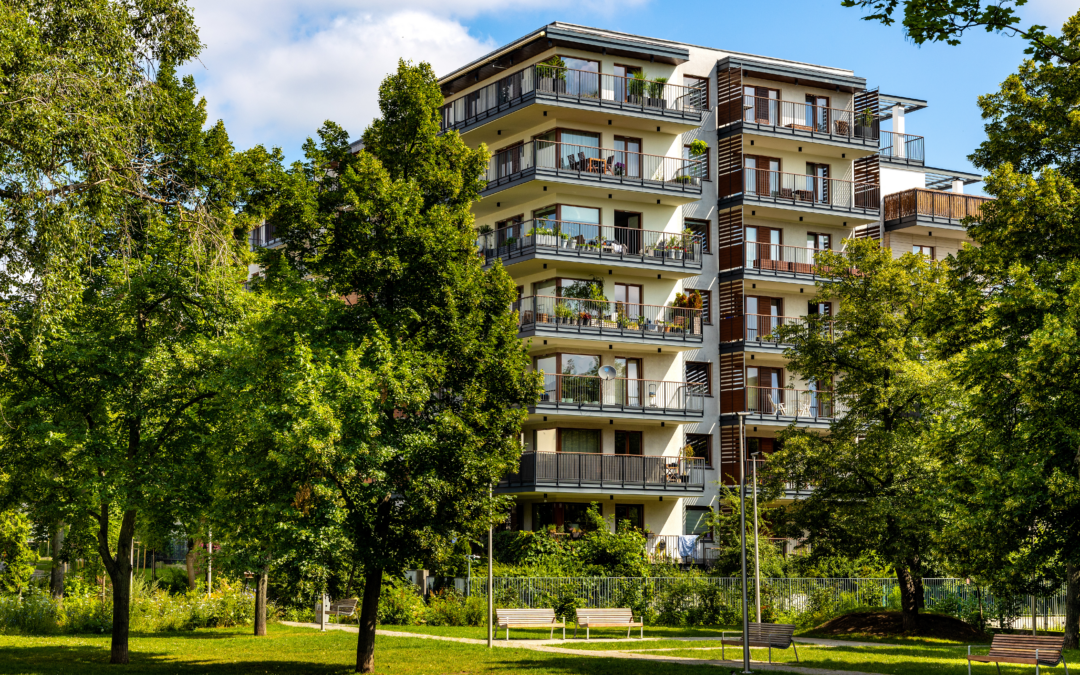
Multifamily energy efficiency is now one of the top cost priorities for MDU operators in 2026. Rising utility rates, tightening state and municipal energy codes, and new federal incentive programs have changed the calculus. Operators who invest in the right upgrades today can cut operating costs, unlock rebates, and increase property value simultaneously.
This guide covers nine proven strategies to improve multifamily energy efficiency across your portfolio — from smart thermostats and HVAC upgrades to IRA tax credits and HUD retrofit grants that can offset most of the upfront cost.
New in 2026: Compliance is now a purchase trigger
– Submetering and energy benchmarking laws are expanding in NY, CA, and CO.
– NYC Local Law 97 is actively fining buildings that exceed carbon limits.
– Federal IRA rebates (45L tax credit) reduce the net cost of qualifying HVAC upgrades.
– Scroll to Strategy 10 for a full breakdown of available incentives.
Multifamily Energy Costs in 2026
Energy remains one of the largest controllable operating costs for multifamily properties. U.S. commercial electricity prices rose approximately 5–8% year-over-year through 2024–2025, according to the U.S. Energy Information Administration (EIA). For MDU operators managing hundreds of units, those increases compound quickly.
The good news: a growing set of technologies — and the federal and state incentives behind them — make it more affordable than ever to upgrade. Whether you own a single building or manage a REIT portfolio, there are strategies below that deliver measurable multifamily energy efficiency gains.
1. Demand Response Programs
Demand response (DR) programs are one of the most dynamic ways to improve multifamily energy efficiency while turning consumption into a revenue stream. DR programs allow multifamily property managers to receive bill credits — or outright cash incentives — when they reduce usage during peak demand periods.
Programs are typically offered by utility providers or third-party aggregators. As a member, you receive advance notice of a forecasted peak usage event. Unless you opt out, your smart thermostats and connected appliances automatically draw less energy. That reduced load is sold back to the grid, and the revenue offsets your next bill.
Verdant’s VX4 smart thermostats fully support demand response integration through Verdant’s DR API, allowing aggregators to push setback events directly to enrolled units. The VX4’s four-phase DR process — pre-conditioning, pre-gap, event, and post-event recovery — protects resident comfort throughout.
2. Installing Smart Thermostats
Smart thermostats are the single highest-ROI upgrade for multifamily energy efficiency. They allow property managers and tenants to optimize heating and cooling around real occupancy patterns — not fixed schedules.
For example, a resident can pre-program the thermostat to reduce energy while they’re at work. It returns to their preferred temperature before they arrive home. In common areas, managers can align temperature settings with peak traffic hours.
MDU operators should note that commercial-grade thermostats are required for multifamily properties. Consumer brands like Nest and Ecobee are built for single-family homes. They lack the multi-unit management, occupancy sensing, and HVAC system integration that larger properties need.
Verdant’s VX4 thermostat is purpose-built for MDU environments. It features passive infrared occupancy detection, flexible setbacks, night occupancy mode, advanced humidity control, and energy savings reporting.
3. HVAC Energy Management Systems
Smart thermostats provide the hardware layer. An HVAC energy management system (EMS) provides the software intelligence on top of it.
By pairing smart thermostats with occupancy sensors and door/window sensors, MDU operators can reduce HVAC runtime by up to 45%. The system ensures no space is overheated or overcooled when unoccupied.
Machine-learning algorithms continuously optimize energy use in real time. The result: automated energy management across every unit and common area in your building.
Smart HVAC systems typically have the shortest payback period of any energy upgrade. Many commercial property managers recoup their investment in 12–18 months. The technology also increases resale value — making it a sound long-term investment.
4. Air Source Heat Pumps
Air Source Heat Pumps (ASHPs) transfer warm or cool air from outside a building to inside. They supplement the central HVAC system, reducing its runtime and energy load. ASHPs are particularly effective in spaces that are harder to control thermally — poorly insulated common areas, laundry rooms, or high-traffic lobbies.
ASHPs are also now eligible for the federal IRA Section 25C tax credit (residential) and may qualify under HUD’s Green and Resilient Retrofit Program for eligible multifamily buildings. See Strategy 10 for details on available incentives.
5. Smart Lighting
Lighting is a significant energy overhead in both residential units and common areas. Smart lighting systems use occupancy sensors to adjust lighting based on real-time use and time of day. They reduce consumption without affecting resident experience.
Many smart lighting systems integrate with third-party energy management platforms. Verdant’s occupancy sensors, for example, can pair with compatible lighting systems so that managers monitor and optimize both HVAC and lighting through a single interface. Some commercial properties have cut lighting energy costs by up to 75% after upgrading to smart LED systems.
6. Energy-Efficient Windows
Energy-efficient windows reduce heat transfer — lowering the demand on HVAC systems year-round. ENERGY STAR-qualified windows filter ultraviolet light and significantly reduce heating and cooling costs, per the U.S. Department of Energy.
Beyond energy savings, new windows increase property value. The financial case is clear for renovation projects — especially in older multifamily stock.
7. Automatic Shutdown Sockets
Standby power — also called “vampire draw” — occurs when plugged-in appliances consume electricity even while switched off. In a multifamily building with hundreds of units, this adds up to meaningful waste.
Automatic Shutdown Sockets are smart power outlets that use timers or infrared sensors to cut power when a device is not in use or the room is unoccupied. They are a low-cost upgrade with immediate impact on baseline energy consumption.
8. Solar Panels
Solar panels reduce reliance on grid electricity and can generate new revenue. Excess production can be sold back to the grid — especially when combined with a demand response program. This creates a two-layer energy cost reduction: lower consumption and new credits.
The federal IRA Investment Tax Credit (ITC) covers up to 30% of solar installation costs for commercial properties. Additional bonuses may apply for low-income communities or properties using domestic equipment. This makes solar a far more financially viable upgrade in 2026 than it was even two years ago.
9. Predictive Maintenance
Predictive maintenance uses sensor data from your HVAC and building systems to identify inefficiencies and potential failures before they become costly. Rather than waiting for a breakdown, maintenance staff can act on performance data.
For instance, HVAC systems fluctuate through varying levels of performance based on occupancy and thermodynamic parameters, and accordingly undergo wear-and-tear on their physical components. However, rather than waiting for a component or entire system to break down or fail completely before being serviced or replaced, Predictive Maintenance allows engineering staff to identify system failures based on system performance, diagnose their causes, and ultimately prevent critical system failures as well as reduce the costs of having to replace components or systems that were allowed to deteriorate beyond repair.
10. Federal and State Rebates for Multifamily Energy Efficiency Upgrades in 2026
Multiple federal and state programs now significantly reduce the upfront cost of energy upgrades. Many MDU operators are leaving substantial money on the table by not claiming them.
Inflation Reduction Act (IRA) — Key Credits for Multifamily
– Section 179D Commercial Energy Efficiency Deduction: Up to $5.00/sq ft for buildings that meet ASHRAE 90.1 energy efficiency standards. Applies to HVAC, lighting, and building envelope upgrades.
– Investment Tax Credit (ITC): 30% credit on solar and battery storage systems installed on commercial or multifamily properties.
– Section 45L New Energy-Efficient Home Credit: Up to $5,000 per dwelling unit for new multifamily construction or substantial renovation meeting ENERGY STAR or Zero Energy Ready standards.
HUD Green and Resilient Retrofit Program (GRRP)
The GRRP provides grants and loans specifically for energy and climate resilience upgrades in HUD-assisted multifamily housing. Eligible improvements include smart HVAC systems, heat pumps, and energy management platforms. Verdant smart thermostats and the VX4 system qualify as eligible energy efficiency measures.
State and Utility Rebates
Most major utility providers offer rebates for commercial smart thermostat installation. Rebates of $25–$75 per thermostat are common through ENERGY STAR utility programs. State-specific programs — such as those in California, New York, Massachusetts, and Illinois — can stack on top of federal credits for additional savings.
Verdant thermostats meet key eligibility requirements across a wide range of programs, including advanced scheduling, occupancy sensing, and EMS integration. Visit Verdant’s Rebates page to find programs available in your state.
Is Your Multifamily Building Ready for 2026 Benchmarking and Submetering Laws?
Energy benchmarking and submetering requirements are expanding rapidly. Property managers who aren’t tracking consumption data now will face compliance gaps — and potential fines — within the next 1–2 years.
– New York City: Local Law 84 requires annual energy benchmarking for buildings over 25,000 sq ft. Local Law 97 sets carbon intensity limits with escalating fines starting in 2024.
– California: AB 802 mandates energy benchmarking and public disclosure for commercial and multifamily buildings over 50,000 sq ft.
– Colorado: SB 246 requires benchmarking and performance standards for large buildings, with compliance pathways rolling out through 2026–2027.
Multifamily Energy Efficiency and Property Investment ROI
Energy costs are an unavoidable overhead for any multifamily property. But the exact amount of that overhead is not fixed. Operators who invest strategically in energy management technology consistently outperform those who don’t.
In 2026, the case for investment is stronger than ever. Federal credits, utility rebates, and compliance mandates create a financial environment where the ROI on smart HVAC upgrades is faster and more certain than at any point in the past decade.
Verdant’s VX4 smart thermostat system is specifically designed for this environment. It delivers the occupancy-based energy management, demand response capability, and portfolio-wide reporting that MDU operators need to reduce costs, meet compliance requirements, and increase property value — all from a single platform.
Ready to improve multifamily energy efficiency at your property? Book a demo to see how Verdant’s VX4 delivers measurable savings — and learn which rebate programs you qualify for.