














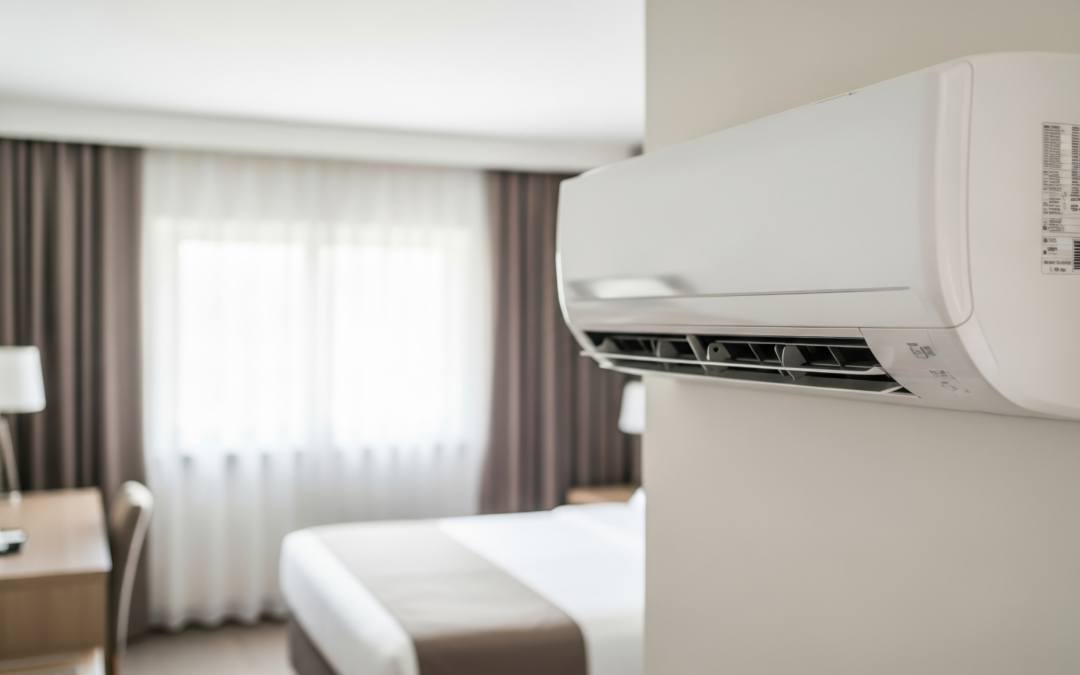
The Problem: How Thermostats Waste 30-40% of Your HVAC Budget
Traditional thermostats maintain uniform temperatures regardless of occupancy. This creates significant energy consumption in unoccupied spaces, the core of thermostat energy waste.
The financial impact is substantial. A property spending $100,000 annually on HVAC energy may waste $30,000-$40,000 per year. Over a decade, that totals $300,000-$400,000 in preventable expenses.
The root cause is simple: conventional thermostats cannot detect occupancy. They treat empty rooms the same as occupied ones, forcing continuous heating or cooling regardless of actual need.
How Traditional Thermostats Create Energy Waste Across Property Types
Traditional thermostats operate on a fixed-temperature model. A single setpoint (typically 70-72°F) maintains throughout the entire facility, 24 hours per day, 7 days per week.
This creates different problems depending on property type:
Hotels: A 100-room hotel maintains 72°F in all rooms, even though only 60% are occupied on average. The 40 empty rooms remain fully conditioned at a cost of $24,000-$32,000 annually.
Multifamily Buildings: A 200-unit apartment complex applies uniform temperature control to both occupied and vacant units. When units turn over between tenants, they remain climate-controlled despite being empty.
Senior Living Communities: Common areas receive full climate control during operating hours and beyond, regardless of actual usage patterns.
Student Housing: During semester breaks, dormitory wings remain fully heated or cooled despite zero occupancy.
Why This Continues
This waste persists because thermostats have no occupancy detection mechanism. Manual adjustments create inconsistency. Programmable thermostats require static schedules that rarely match actual occupancy.
Why Simple Fixes Don’t Work (And Why Your Facilities Team Knows It)
Property managers attempt partial solutions, believing they’ll address the problem. They don’t. Each common approach has fundamental limitations:
Temperature Setbacks: These reduce consumption during low-occupancy periods—until occupants return. Then systems work intensively to restore target temperatures, consuming extra energy during “recovery.” Savings often disappear.
Manual Adjustments: Staff can adjust settings manually. But personnel forget. Settings change back. Different staff members adjust differently. Consistency doesn’t last.
Motion Sensors: Motion-detection systems seem logical but fail repeatedly. A propped door suggests occupancy when empty. A sleeping guest produces no motion, causing unexpected temperature reductions.
The Bottom Line: These approaches reduce consumption by 5-10% at best. You’re still wasting 25-35% of HVAC costs.
The Real Solution: Occupancy-Based Intelligent Control Systems
Addressing thermostat energy waste requires systems with five critical capabilities:
– Reliable Occupancy Detection: Distinguishes occupied periods (including sleep) from unoccupied periods
– Real-Time Responsiveness: Adapts control based on actual conditions, not preset schedules
– Comfort Preservation: Maintains target temperatures during occupied periods without exception
– Aggressive Unoccupied Control: Reduces temperature significantly when spaces are empty
– Continuous Learning: Optimizes based on your facility’s unique patterns
What Research Shows
Field studies of occupancy-centric smart thermostat systems demonstrate energy savings ranging from 3% to 35% compared to non-setback operation. Advanced systems employing occupancy sensing and optimized algorithms achieve average energy savings of 28%.
Commercial implementations show even stronger results. Hotels achieve up to 45% HVAC runtime reduction in unoccupied rooms. Unlike manual solutions, intelligent occupancy-based control eliminates waste while preserving comfort.
Why Thermostat Energy Waste Persists Despite Awareness
Many property managers understand the waste exists but fail to address it. This gap between awareness and action stems from real operational barriers.
The Perception of Technical Complexity
Property managers frequently view smart thermostat systems as complicated to implement and maintain. Concerns about system integration, software compatibility, and operational disruptions discourage evaluation of advanced solutions.
When facilities teams lack experience with networked HVAC systems, deploying sophisticated occupancy-based controls generates legitimate apprehension about reliability and performance.
Budget Constraints Competing for Attention
Although thermostat waste represents significant ongoing costs, upfront investment must compete against other building system priorities. Facilities teams struggle to justify energy management investments when other systems require maintenance or repairs.
Staff Resistance and Workflow Disruption
Operational procedures around temperature management have become routine. Front desk personnel, maintenance teams, and administrative staff develop workflows around current thermostat operation.
Introduction of new systems requires staff retraining and workflow adjustments—creating organizational friction that slows implementation timelines.
Making Implementation Actually Work
Addressing this effectively requires overcoming these obstacles alongside technology deployment. Property managers must view implementation as an organizational change initiative, not merely a technology upgrade.
This perspective transforms implementation from a technical undertaking into a managed organizational transition. It accounts for staff concerns, operational continuity, and business process modifications.
The True Cost of Deferring Thermostat Energy Waste Solutions
Beyond direct energy costs, deferring action creates strategic disadvantages that accumulate over time.
Competitive Positioning Deteriorates
Properties maintaining older thermostat technology lose appeal to quality-conscious tenants and guests who prioritize sustainability. Hotels competing for premium guests, multifamily properties attracting younger demographics, and senior living communities differentiating on modern amenities all face disadvantages.
Regulatory Risk Increases Steadily
Energy efficiency standards strengthen across jurisdictions. Requirements for performance benchmarking, sustainability reporting, and minimum efficiency standards expand regularly.
Properties deferring action may eventually face compliance mandates requiring expensive emergency upgrades or operational restrictions. Proactive implementation allows properties to address requirements on their own timeline.
Organizational Confidence Declines
Once staff understand that current systems waste substantial resources, continued reliance on outdated technology undermines confidence in management decision-making. Facilities teams recognize inefficiency and question why leadership fails to address controllable costs.
Financial Performance Becomes Less Predictable
Energy price volatility means thermostat waste expands and contracts with market conditions. Properties depending on traditional thermostats experience greater earnings volatility and reduced predictability in operational cost projections.
This unpredictability complicates financial planning and creates obstacles to property valuations and refinancing.
Market Value Declines
Properties with high energy costs trade at valuation discounts compared to similar properties with controlled consumption. As sustainability metrics become standard in property valuations, the financial penalty intensifies.
Secondary Consequences of Thermostat Energy Waste
Beyond direct energy costs, inefficient thermostat performance creates additional problems:
HVAC System Degradation: Continuous operation accelerates wear on furnaces and air conditioning units. Maintenance costs increase. Equipment lifespan decreases. Emergency repairs become more frequent.
ESG Goal Failure: Properties with high per-unit energy consumption struggle to meet environmental, social, and governance (ESG) standards. These targets increasingly influence property valuations, insurance rates, and tenant/guest preferences.
Missed Financial Incentives: Utility rebates for efficiency upgrades—typically $50-$150 per unit—require baseline efficiency standards. Properties with substantial thermostat waste remain ineligible.
Competitive Disadvantage: Modern property seekers prioritize energy-efficient facilities. Unnecessary thermostat waste signals operational inefficiency.
Understanding Thermostat Performance Standards
Commercial properties in variable-occupancy scenarios achieve significantly higher percentages. Properties with high occupancy variability see maximum thermostat waste—and therefore maximum savings potential from intelligent systems.
Implementation Reality: What Actually Happens
Addressing thermostat waste requires replacing or supplementing existing thermostats with occupancy-responsive systems. Implementation involves:
– Sensor installation for reliable occupancy detection
– Integration with existing HVAC systems
– Software deployment for intelligent control
– Staff familiarization with new interfaces
Most commercial properties complete implementation in 2-7 days with minimal disruption. Investment typically recovers through reduced energy consumption within 12-24 months.
What You Should Look For in a Next-Generation Thermostat
Not all smart thermostats are created equal. When evaluating options, prioritize:
Occupancy Detection That Works at Night: Advanced systems use multiple sensor types (not just motion) to reliably detect occupancy even when guests are sleeping or stationary.
HVAC System Compatibility: Does it work with your HVAC setup (furnace, heat pump, VRF, split systems)? Can it integrate with your PMS (Property Management System)?
Machine Learning Capabilities: The system should learn your building’s patterns and continuously optimize, not just follow preset rules.
Remote Management: Centralized control allows property managers to override settings, monitor performance, and adjust in real-time.
Real-Time Reporting: You should see exactly where energy is being wasted, with granular data by zone or unit.
Conclusion: The Case for Action
Thermostat waste represents the most controllable category of operational expense in commercial properties. Traditional thermostats have inherent limitations that prevent addressing this through manual intervention.
Modern occupancy-based systems eliminate this waste while maintaining occupant comfort. For most properties, investment payback occurs within 12-24 months, with subsequent years yielding 100% margin contribution from reduced energy costs.
The question is not whether eliminating thermostat waste is economically justified. The question is how much longer your property can operate with preventable inefficiency.
Ready to Eliminate Thermostat Energy Waste?
Verdant’s intelligent energy management systems reduce HVAC runtime by up to 45% while maintaining occupant and guest comfort. Property managers across hotels, multifamily buildings, senior living communities, and student housing facilities rely on Verdant solutions to eliminate thermostat waste and recover capital investment rapidly.
Schedule a personalized assessment to quantify thermostat waste at your property.