














Hotel PMS integration now separates properties into two groups. Some run efficient, data-driven operations. Others still manage energy, comfort, and staffing in disconnected silos. A Property Management System is already the operational heart of most hotels — governing reservations, check-in, housekeeping, and billing. But the true value of a modern PMS isn’t what it manages on its own. It’s what it unlocks when connected to the rest of the property’s technology stack: smart thermostats, door locks, lighting systems, building management systems, and water monitoring.
Energy is where the opportunity is largest. HVAC accounts for 50–60% of a hotel’s total energy consumption, and the majority of that energy is wasted conditioning rooms that are empty. When a hotel’s smart thermostats are integrated with its PMS, the system knows in real time which rooms are occupied, checked out, or reserved for imminent arrival. It then adjusts temperature accordingly without staff intervention.
Verdant solutions built its energy management system specifically for this connected model. Compatible with leading PMS platforms including Opera, MEWS, and HotelKey, Verdant solutions integrate HVAC control, occupancy detection, and real-time energy reporting into the same operational framework hotel managers already use to run their properties.
The integration opportunity: A hotel’s PMS knows when a room checks out. Verdant’s system uses that signal to immediately enter energy-saving setback mode, then pre-conditions the room before the next guest arrives. No staff action required. No energy wasted.
What Hotel PMS Integration Actually Means for Energy Management
In hotel energy management, PMS integration refers to a live, two-way data connection. It links a property management system with HVAC and room control infrastructure. When a guest checks out, the PMS triggers the energy management system to reduce HVAC output.
When a reservation is assigned and check-in approaches, the system pre-conditions the room. This ensures guests arrive to a comfortable environment without running HVAC at full capacity for hours in an empty room.
Without this connection, most hotels operate on one of two inefficient defaults: running HVAC continuously at guest-comfort temperatures regardless of occupancy, or relying on staff to manually adjust settings room by room — a process that is inconsistent at best and frequently overlooked.
Hotel PMS integration eliminates both problems. Verdant’s API connects directly to PMS platforms, allowing occupancy-based automation that responds to actual guest behavior rather than fixed schedules. The result is an average 45% reduction in guestroom HVAC runtime. This translates to 15–18% savings on total energy costs. Typical payback periods range from 12–18 months.
Smart Thermostats: The Foundation of a Connected Hotel
Commercial-grade smart thermostats are the hardware layer that makes hotel PMS integration functional at the room level. When it comes to hotel smart thermostats, they need to handle continuous occupancy fluctuation, multi-zone management, brand compliance requirements, and integration with third-party systems. All without requiring guest interaction to function correctly.
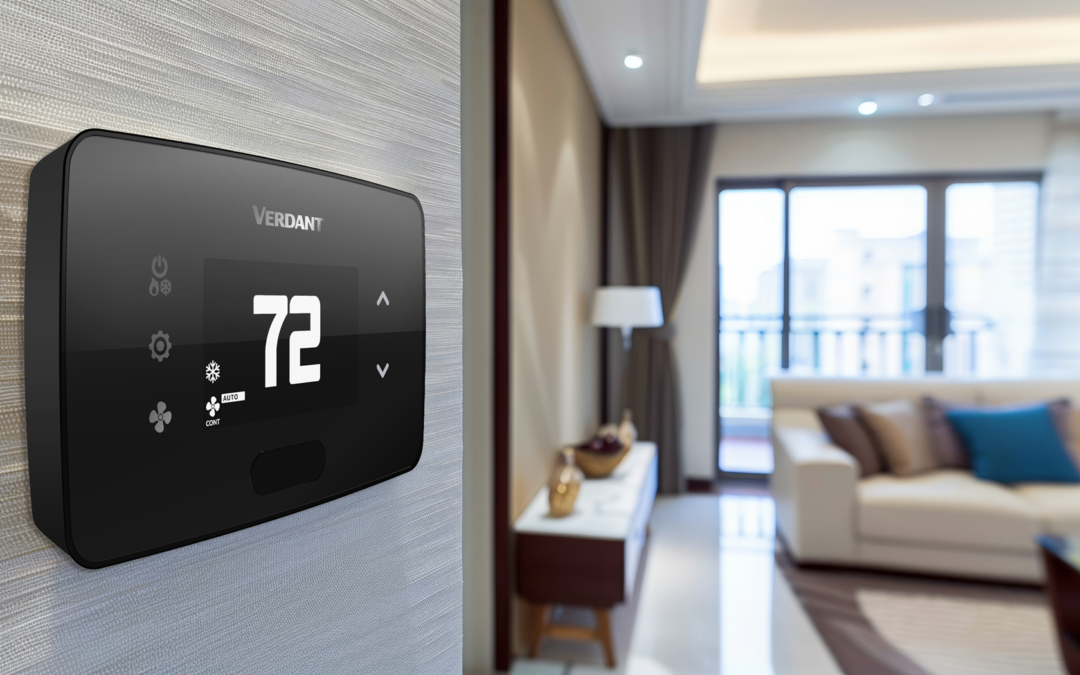
Verdant’s VX4, VX, and ZX thermostats are built for this environment. Each unit includes a built-in PIR occupancy sensor that continuously scans for human motion and body heat. It sets back HVAC output the moment a guest leaves and restores comfort when they return.
Key features that distinguish commercial from residential performance include:
– Dynamic Intelligent Recovery: the thermostat learns each room’s thermal characteristics and pre-calculates the optimal setback depth to ensure recovery within a configured timeframe, regardless of outdoor conditions.
– Night Occupancy Mode: automatically disables temperature setbacks while guests are asleep, preventing disruptions during nighttime hours without requiring extra hardware.
– Flexible Setbacks: operators set minimum and maximum temperature bounds during unoccupied periods, ensuring rooms never reach conditions that damage equipment or compromise air quality.
– Remote Control via Verdant Thermostat Manager: property staff can view and adjust any room’s settings from a centralized dashboard on desktop, iOS, or Android.
How Verdant Thermostats Integrate with Hotel PMS Platforms
Verdant solutions integrate with hotel property management systems through a secure API connection. This enables real-time data exchange between reservation status and in-room HVAC behavior.
When the PMS confirms a room as checked out, the system automatically shifts the thermostat to an unoccupied setback. When the next reservation is assigned and pre-arrival time is triggered, the thermostat begins conditioning the room toward guest-comfort temperature well before arrival.
Supported PMS Platforms
Verdant’s energy management system integrates with major PMS providers including:
– Opera (Oracle Hospitality) — the most widely deployed enterprise PMS across branded full-service hotels
– MEWS — a cloud-native PMS platform with growing adoption in boutique and independent properties
– HotelKey — purpose-built for select-service and limited-service brands
For properties using other PMS platforms, Verdant’s open API supports custom integration, and the system can also operate in standalone occupancy-sensing mode when PMS connectivity is unavailable or not yet configured.
Integration with Door Lock Systems
For properties where PMS-level check-in data is supplemented by physical access events, Verdant integrates with leading door lock systems. The list includes Assa Abloy, Onity, Dormakaba, and many more. When a guest uses their keycard or mobile key, the door lock event confirms occupancy and triggers the thermostat to begin recovery to guest-comfort temperature. When a guest secures the door from outside, the system begins setback after a configurable delay.
This dual-signal approach — combining PMS reservation data with door lock events — produces more accurate occupancy detection than either signal alone, reducing false setbacks and improving guest comfort during the first minutes after room entry.
Why dual-signal matters: With a hotel PMS integration, the system knows that a room is reserved but not whether the guest has physically arrived. A door lock confirms entry but not departure intent. Combined, the two signals give the energy management system near-perfect occupancy awareness — which is what drives maximum savings without comfort trade-offs.
Smart Lighting Integration and Hotel IoT Energy Management
Lighting accounts for a significant share of hotel energy consumption beyond HVAC. Smart lighting systems that integrate with the same occupancy sensing infrastructure further increase savings.
When Verdant thermostats detect that a guestroom is unoccupied, the same occupancy signal can be passed to compatible smart lighting controls — automatically dimming or switching off lights without guest or staff action.
In common areas including lobbies, corridors, meeting rooms, and fitness centers, scheduled lighting controls informed by PMS occupancy data ensure that the system appropriately lights spaces during peak periods and scales back lighting during low-traffic hours. Verdant’s energy management platform integrates with existing Property Management Systems and smart lighting infrastructure through BACnet, Zigbee, Bluetooth, and REST API protocols, enabling hotel managers to control both climate and lighting from a single operational interface.
The result is an IoT energy management ecosystem. It uses real occupancy data to control both room-level and common-area energy use. This eliminates the structural waste that fixed schedules cannot address.
Building Management System Integration for Whole-Property Control
A hotel building management system (BMS) serves as the operational backbone. It connects HVAC, lighting, electrical, security, and other systems into a unified monitoring and control system.
Verdant’s energy management solutions integrate with BMS infrastructure through open communication protocols — BACnet and Modbus in particular — so the smart thermostat network actively contributes to property-wide energy efficiency rather than operating as an isolated system.
Through BMS integration, property engineering teams gain room-level and zone-level HVAC data that would otherwise require them to use separate reporting platforms. Verdant’s Thermostat Manager surfaces runtime data, setpoint adherence, occupancy patterns, and equipment performance alerts that engineering staff can review and act on from a centralized dashboard. The system detects faults— such as a unit failing to reach setpoint after extended runtime — and triggers alerts before the issue escalates to a guest complaint or equipment failure.
For multi-property ownership groups, BMS integration combined with Verdant’s portfolio-level reporting creates visibility across an entire asset base, allowing regional operations teams to compare property performance, identify outliers, and roll out setting changes without visting each property.
Demand Response Programs: Turning Energy Management into Revenue
Hotel demand response programs represent one of the most underutilized financial levers available to energy management operators. Utility providers or third-party aggregators administer demand response programs, enabling hotels to reduce HVAC and other energy-intensive loads during peak grid demand periods and receive financial incentives in return.
The mechanism works as follows: utility providers forecast high-demand events and notify participating properties in advance. Verdant’s system can automatically pre-condition rooms before a demand response event begins — bringing rooms to optimal temperature before the peak window — then reducing HVAC output during the event itself. Because rooms already maintain comfortable temperatures and occupancy-sensing setbacks remain active, guests rarely notice any difference in comfort.
In participating utility territories, demand response participation can offset a meaningful portion of Verdant’s deployment costs, and in some programs, generates ongoing credit against energy bills. Utility rebates can cover a significant portion of equipment costs in certain jurisdictions, and further accelerate the already-short payback period.
Smart Room Integration: Branded Hotel Systems and Guest Experience
For properties operating under major brand flags, corporate teams increasingly specify smart room technology requirements. Verdant’s energy management system holds approved vendor status with IHG Hotels & Resorts, and Marriott, and integrates with brand-specific guestroom management systems including Hilton’s PEP platform, Marriott’s GRMS, and IHG® Studio.
These integrations enable centralized brand compliance monitoring while allowing individual properties the flexibility to configure energy-saving parameters within brand-approved ranges. Operators can set minimum and maximum setpoint limits, configure recovery timeframes, and establish common area schedules — all within the brand’s operational guidelines — through Verdant’s management platform.
For guests, the integrated experience is seamless. Rooms are comfortable at arrival, and the system maintains guest temperature preferences throughout the stay. Energy-saving modes activate only when rooms are genuinely unoccupied. Night Occupancy Mode ensures that no setback interrupts a sleeping guest, preserving satisfaction scores that are central to brand performance assessments.
Water Leak Detection: Extending the Sensor Network Beyond HVAC
Once a hotel deploys a sensor network for occupancy-based energy management, it can extend that network further. One key use is addressing water damage—one of hospitality’s most costly and least visible risks.
Undetected leaks beneath sinks, behind appliances, and in mechanical spaces cause an average insurance claim of $13,954 per incident. In a hotel context, that figure compounds rapidly when operators factor in room displacement, repair downtime, and guest disruption.
Verdant’s water leak detection sensors integrate directly with the Verdant Thermostat Manager platform, sending real-time text alerts to property staff the moment the system detects moisture. Three sensor types address different exposure points across a hotel property:
– Water Leak Probe (ZX-WLS-P) — compact detection for guestroom high-risk areas: under sinks, beside toilets, behind minibars.
– Flood Cable (ZX-WLS-FC) — perimeter detection for laundry rooms, mechanical spaces, and areas surrounding large appliances.
– Float Switch (ZX-WLS-FS) — prevents HVAC drip pan overflow, protecting equipment from the type of water intrusion that is both invisible and expensive to repair.
Combined with Verdant’s temperature and humidity sensors, which flag high-humidity conditions that precede mold growth, the system provides a complete environmental monitoring layer that protects physical assets, reduces insurance exposure, and catches infrastructure issues before they affect guests.
Getting Started: Integration, Deployment, and ROI
Verdant’s designed its deployment model to minimize the barriers that typically slow hotel technology adoption. Each thermostat installs in under 15 minutes and requires no licensed electrician. Only one Online Connection Kit is needed to connect up to 1,000 thermostats to a single networked management system. Verdant solutions configure PMS integration through its API, and users can access the Thermostat Manager platform on desktop, iOS, and Android from day one.
For properties already running major PMS platforms, integration typically takes days rather than weeks. For properties with existing HVAC infrastructure — regardless of manufacturer or system type — Verdant’s compatibility with PTACs, VTACs, fan coil units, split systems, and VRF units means virtually no property requires infrastructure replacement before deployment.
The financial case is straightforward. Most properties see an average HVAC runtime reduction of 45% in guestrooms, translating to 15–18% savings on total energy costs. Hotel PMS integration through Verdant represents one of the highest-return technology investments available to hotel operators in 2026.
The hotels that are pulling ahead operationally are not simply upgrading individual systems. They are building a connected infrastructure, in which PMS data drives thermostat behavior, occupancy sensing informs lighting control, water sensors protect physical assets, and teams can view all of it in a single management platform. Hotel PMS integration is the framework that makes that infrastructure coherent. Verdant is the system that makes it practical.
Ready to reduce energy costs and improve operations at your hotel?